Commercial
Roofing Contractor
Flat, metal, and coated roof systems across Florida — installed around your operating hours, documented for your capital plan, and warrantied in writing before anyone sets foot on the building.
A Commercial Roof
Is a Budget Line
A homeowner asks what a roof costs. A property manager asks what it costs, when it can be scheduled, how long the building is disrupted, what the warranty covers, and what to put in next year's capital plan.
Those are different questions, and they need different answers. We work regularly with property managers, condo and HOA boards, facility managers, and owner-occupiers — and the paperwork matters as much as the membrane.
What that means in practice: written condition reports you can take to a board, phased scheduling that works around tenants and operating hours, and pricing broken out per building rather than one number for the whole property.
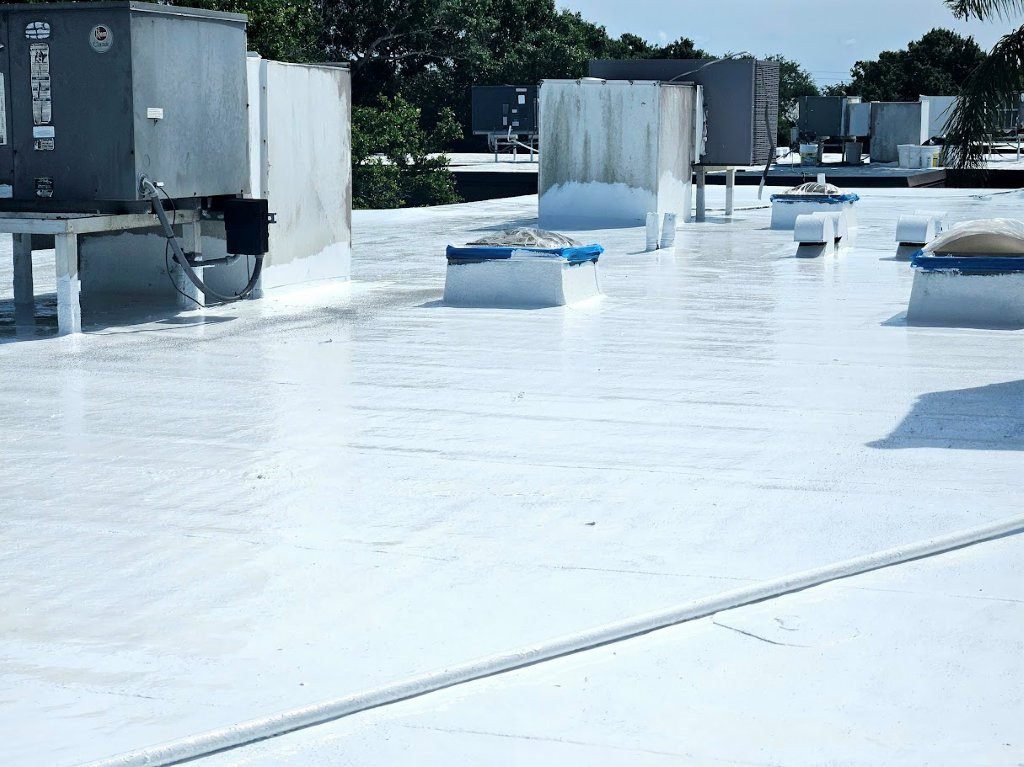
Commercial replacement, Palm Beach County
Four Systems,
Four Different Answers
Most Florida commercial roofs are flat or low-slope. Which system is right depends on your building, your rooftop traffic, and whether you're replacing or restoring.
| Typical life | Best suited to | |
|---|---|---|
| TPO membrane | 20–25 years | The Florida default. Reflective white surface, heat-welded seams, strong value. Warehouses, offices, retail. |
| EPDM rubber | 20–30 years | Excellent flexibility and weather resistance. Good where chemical exposure or extreme movement is a factor. |
| Modified bitumen | 15–25 years | Multi-ply, high puncture resistance. The right call where there's regular rooftop foot traffic or heavy HVAC. |
| Silicone coating | 10–20 years | Restoration rather than replacement. Seamless, monolithic, and installed over a sound existing roof. |
We install GAF and Polyglass systems, among others. Manufacturer approvals matter on commercial work because they determine which warranty you're eligible for — see the warranty section below.
Restore or Replace?
On a commercial building this single question can be a six-figure difference, and it's decided by the condition of what's underneath — not by what a contractor would rather sell.
Restoration works when the existing membrane is sound, the insulation is dry, and the deck is solid. A silicone coating goes over the top, seals every seam and penetration, and resets the clock at a fraction of tear-off cost — with no disruption to the building below and no landfill.
Replacement is necessary when moisture has reached the insulation. Coating over wet insulation traps the water, and the roof fails faster than if you'd done nothing. That's not a judgment call — it's a moisture survey.
We core-sample or scan before recommending either. If your roof is a candidate for restoration, that's what we'll quote.
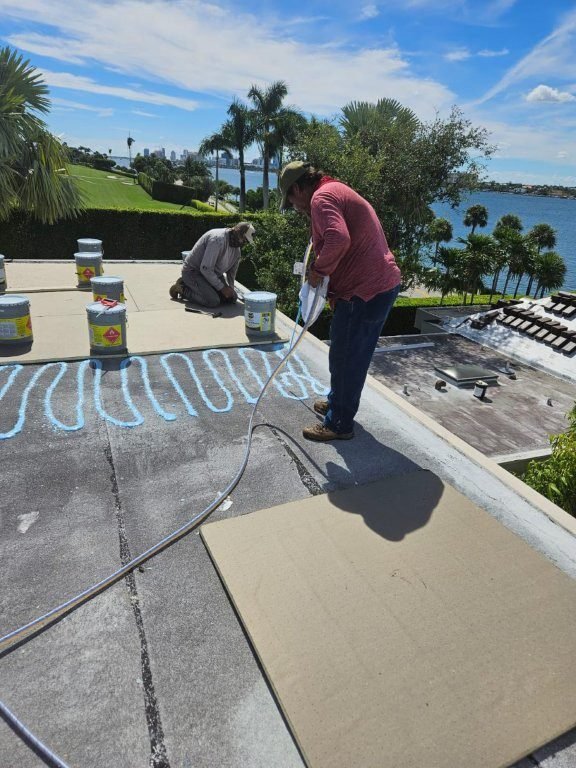
TPO membrane — heat-welded seams, reflective surface
Ponding Water — the Florida Flat Roof Question
Industry standard treats water still standing 48 hours after rain as ponding. It's the most common flat roof issue we're called about, and it's rarely the membrane's fault — it's drainage, slope, or a blocked scupper.
Ponding accelerates every other failure mode. It degrades membrane, adds structural load, and voids some manufacturer warranties outright. If your roof holds water two days after a storm, the coating or membrane isn't the first thing to fix. We'll tell you that rather than selling you a system that will fail the same way.
Not All Commercial
Warranties Are Equal
This is the part of a commercial roofing quote that most people skim, and it's where the real difference between two bids usually sits.
Manufacturer NDL Warranty
A No Dollar Limit warranty means the manufacturer covers labor and materials to repair a covered failure, with no cap. They're only available through approved contractors, on approved system assemblies, and after the manufacturer inspects the finished roof. That inspection is the point — someone other than your contractor signs off on the work.
Standard Material Warranty
Covers the material only. If the membrane fails, you get membrane — you pay the labor to remove and reinstall, which on a commercial roof is most of the cost. Perfectly legitimate, and considerably less coverage than an NDL.
Our Workmanship Warranty
[WARR-WORK] years in writing, covering installation. Manufacturer warranties don't cover workmanship, and workmanship is where most roofs actually fail. You want both.
When you compare bids, ask each contractor which warranty their specification qualifies for and whether the manufacturer will inspect. It's a fair question and the answers are revealing.
Working Around
Your Business
On a house, disruption means a noisy week. On a commercial property it means lost trading, unhappy tenants, and a board asking why nobody was warned.
Phased Scheduling
Large properties done in sections so parking, entrances, and access stay usable. Sequence agreed before work starts, not improvised on site.
Off-Hours Where Needed
Tear-off over a weekend, or early starts before trading. Costs more and it's often worth it — we'll price both so you can decide.
Tenant Notification
We'll give you the notice text and the schedule to distribute, far enough ahead that your office isn't fielding calls on day one.
Rooftop Equipment
HVAC units, exhaust fans, and satellite equipment protected and re-flashed properly. Curbs and penetrations are where flat roofs actually leak.
Daily Site Control
Debris contained, walkways swept, magnet sweep of parking areas every evening. Your tenants shouldn't be finding fasteners in their tires.
One Point of Contact
A name and a number for the duration. Not a rotating cast, and not a call center that takes a message.
Roof Maintenance Programs
The cheapest commercial roof is the one that reaches its full service life. Most don't — they fail early from blocked drains, unsealed penetrations, and small punctures nobody noticed.
A scheduled maintenance program means twice-yearly inspections with a written report, drains and scuppers cleared, seams and flashings checked, minor repairs handled before they become claims, and a documented roof history you can hand to a board, a buyer, or an insurer.
It also protects your warranty. Most manufacturer warranties require documented maintenance — and the first thing a manufacturer asks for when a claim is filed is the inspection record. Ask us about a program for your property →
How a Commercial
Project Runs
Site survey and moisture assessment
We walk the roof, check drainage, inspect penetrations and flashings, and establish whether the insulation beneath is dry. That last one decides restoration versus replacement.
Written condition report
Photographs, findings, and recommended options with pricing for each. Formatted so you can put it in front of a board or an owner without rewriting it.
System specification
Membrane or coating selected for your building, your rooftop traffic, and the warranty you want to qualify for. We name the manufacturer and the system on the proposal.
Scheduling and notification
Sequence agreed around your operating hours, permits filed, and tenant notification prepared. Everyone knows what's happening before anything starts.
Installation
Licensed crews, daily site control, and progress photographs. Rooftop equipment protected and re-flashed rather than worked around.
Inspection and close-out
County inspection passed, manufacturer inspection scheduled where an NDL warranty applies, and the complete document package delivered — photos, permits, warranty registration, and maintenance schedule.
Commercial Roofing FAQs
What's the most common commercial roof system in Florida?
TPO membrane, by a wide margin. The reflective white surface suits our sun, heat-welded seams perform well in heavy rain, and it offers strong value per square foot. EPDM, modified bitumen, and silicone restoration coatings all have their place depending on the building and its rooftop traffic.
How long does a commercial roof last?
Typically 20 to 30 years for a properly installed membrane system, less in high-traffic or high-exposure conditions. Documented maintenance is the single biggest factor — most commercial roofs that fail early do so from blocked drains and unsealed penetrations, not from membrane failure.
Can I coat my roof instead of replacing it?
Often, and it's usually far cheaper. Restoration works when the membrane is sound and the insulation beneath is dry. If moisture has reached the insulation, coating over it traps the water and the roof fails faster than if you'd left it. We survey for moisture before recommending either — it's a measurement, not an opinion. See silicone roof coating.
What is an NDL warranty?
No Dollar Limit — the manufacturer covers labor and materials to repair a covered failure with no cap. They're only available through approved contractors on approved assemblies, and the manufacturer inspects the finished roof before issuing one. That third-party inspection is the real value. A standard material warranty covers the material only, leaving you to pay the labor, which on a commercial roof is most of the cost.
Will you work around our business hours?
Yes. Phased scheduling, weekend tear-offs, and early starts are all workable — they cost more and we'll price both options so you can weigh the disruption against the difference. We also provide tenant notification text and a schedule you can distribute ahead of time.
Do you handle storm damage on commercial buildings?
Yes — emergency response, temporary stabilization, and thorough documentation. We're roofing contractors rather than public adjusters, so we don't handle claims. What we provide is the dated photographic record of the damage, the likely cause, and the work performed. That file is yours, and it's what your carrier or your own adjuster will ask for.
Do you offer maintenance programs?
Yes. Twice-yearly inspections with written reports, drains and scuppers cleared, seams and flashings checked, and minor repairs handled before they escalate. It also protects your warranty — most manufacturers require documented maintenance, and the inspection record is the first thing they ask for on a claim.
Which areas do you serve?
We're licensed statewide, with crews working regularly through Martin, St. Lucie, Palm Beach, Broward, and Southwest Florida — including Stuart, Port St. Lucie, West Palm Beach, Boca Raton, Fort Lauderdale, Naples, and Fort Myers.
Related
Flat roof systems in detail: TPO membrane and silicone restoration coating. For metal on commercial buildings see standing seam.
Also relevant: roof leak repair, 24/7 emergency response, and roof inspections. For residential properties within a managed community, see residential roof replacement.
Get a Written
Condition Report
Free site survey, photographs, moisture assessment, and options priced separately — formatted so you can put it straight in front of a board or an owner.