5V Crimp
Metal Roof
The most affordable way to put a real metal roof on a Florida building — and the profile that's been doing it here for a century. Straightforward, proven, and honest about what it is.
Where the Name
Comes From
Look at the seam where two 5V panels meet and you'll count five V-shaped ribs — two at each panel edge, plus one running down the centre of the pan.
That's the whole design, and it hasn't needed changing. The ribs stiffen the panel so it spans without buckling, the overlapping edge Vs shed water away from the joint, and screws with sealing washers hold the whole thing down through the face of the panel.
It's the roof on Old Florida cottages, packing houses, fish camps, and farm buildings from Ocala to the Keys — and it's come back into favour on new construction because that vernacular look is genuinely hard to fake with anything else.
It is also, by a clear margin, the least expensive metal roof we install.
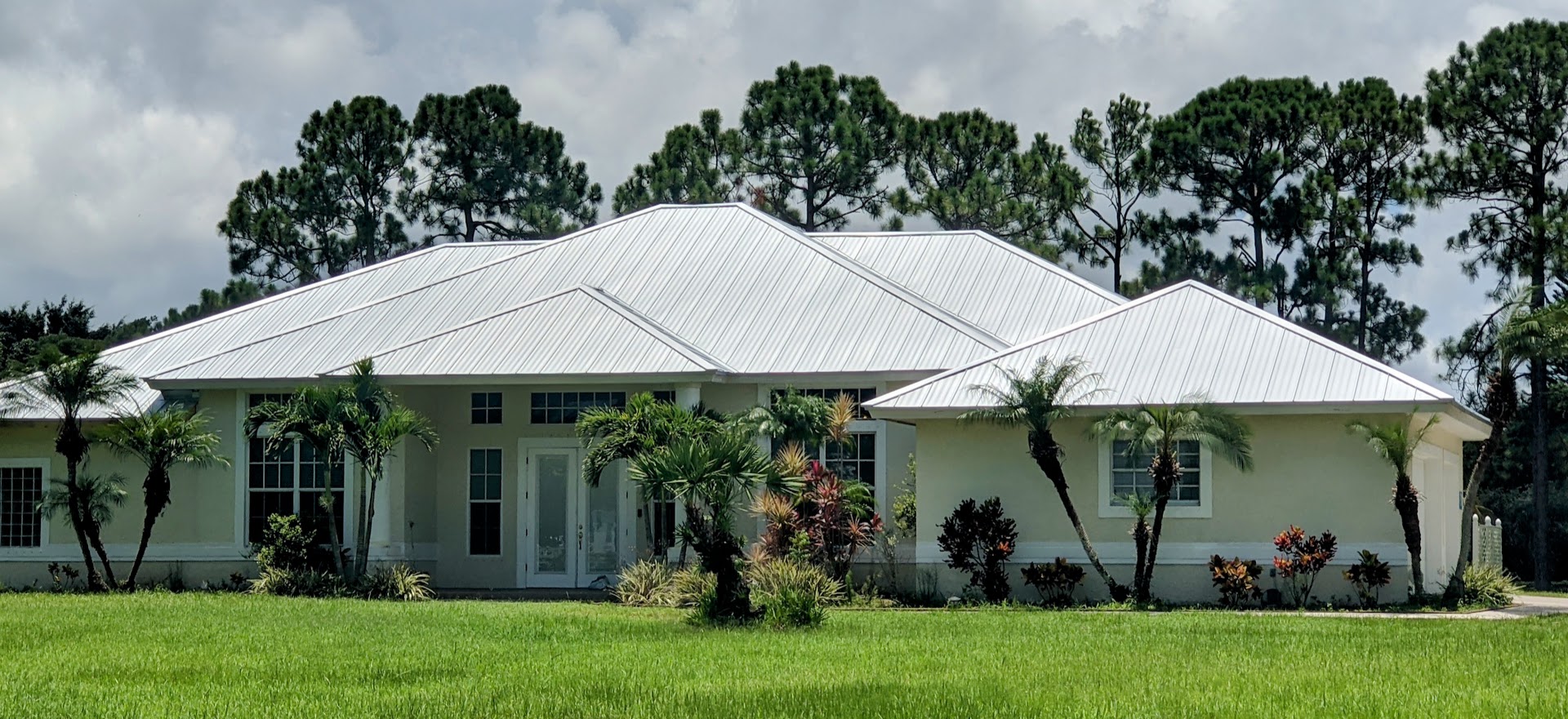 >
>5V crimp panel installed in Florida by Expert Roofing Services
Is 5V Right
for Your Building?
This is the section most product pages leave out. 5V is an excellent roof on the right building and the wrong call on others — so here's how we'd judge it.
5V Makes Sense For
- Barns, workshops, garages, and outbuildings where value matters more than finish
- Old Florida, Cracker, cottage, and farmhouse architecture where the look is the point
- Owners who want a genuine metal roof at the lowest realistic cost
- Simple roof shapes with few penetrations and long clean runs
- Buildings where you can get up and check fasteners every few years
- Additions and porches matching an existing 5V roof
Look at Standing Seam Instead If
- You're within a mile of open salt water and want the longest possible life
- You want a roof you never have to think about again
- Your HOA restricts exposed-fastener panels — many do
- The roof is complex, with lots of valleys, hips, and penetrations
- You're building a contemporary home where clean lines matter
- You plan to be in the house for thirty-plus years
We install both, and we'd rather point you at the right one. See standing seam →
Exposed Fasteners
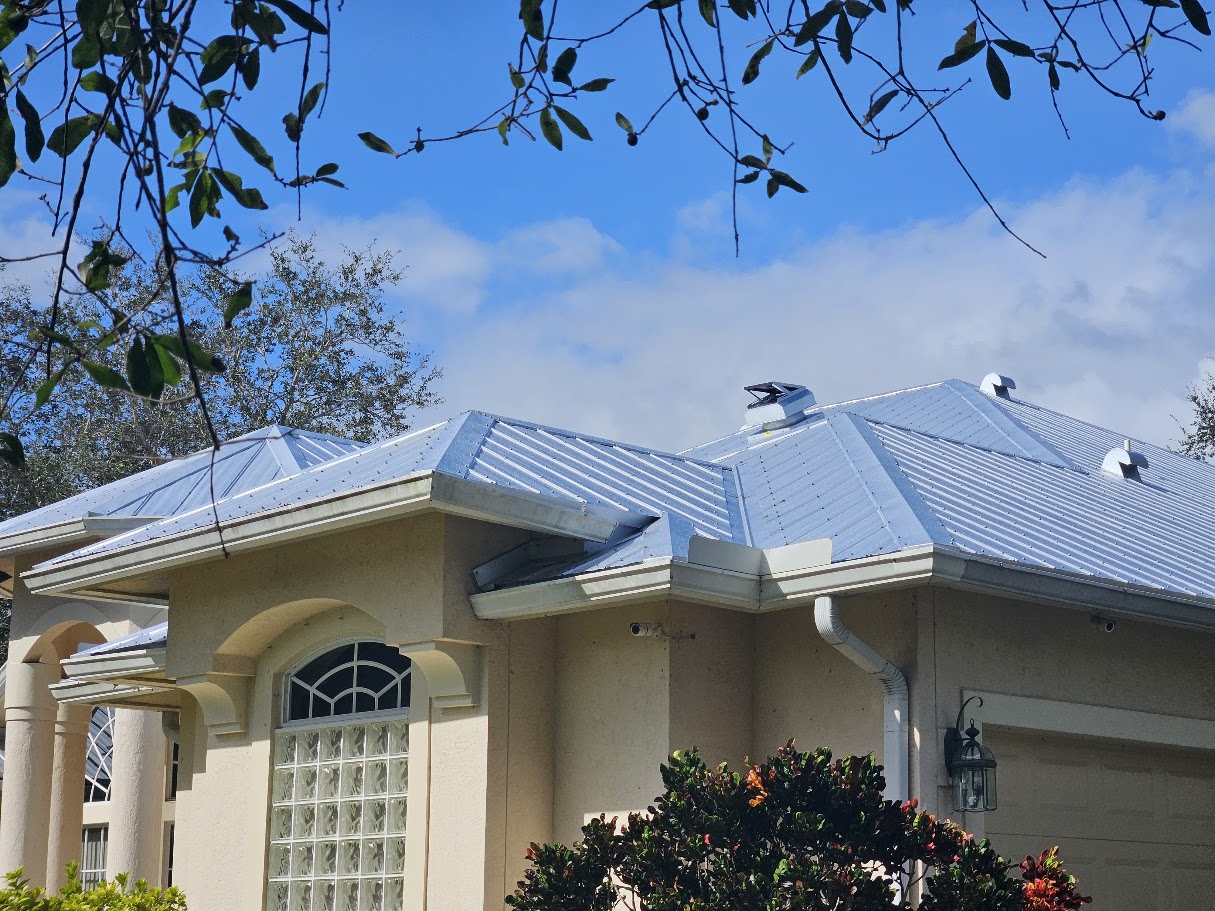
5V costs less than standing seam for one structural reason: the screws go through the face of the panel rather than hiding behind a seam.
Each screw carries a sealing washer that compresses against the metal to keep water out. Those washers are what stands between your building and every rainstorm for the next few decades — and in Florida sun they eventually harden and lose compression.
That's not a flaw. It's the trade-off, and it's entirely manageable — provided somebody tells you about it before you sign, and provided you plan for it.
Expect to have fasteners inspected and re-torqued periodically, and replaced at some point in the roof's life. It's inexpensive, it's quick, and it's the difference between a 5V roof that gives you thirty years and one that starts weeping at fifteen.
 -->
-->Why We Won't Claim 50 Years
You'll see 5V advertised with the same lifespan figures as standing seam. We won't do that, because the fastener washers are a wear item and standing seam doesn't have them.
A realistic expectation for a well-installed 5V roof in Florida is 30 to 45 years, with fastener maintenance along the way. Neglect the fasteners and you'll get considerably less. Look after them and 5V will outlast two shingle roofs comfortably — at a cost much closer to one.
5V or Standing Seam?
| 5V Crimp | Standing Seam | |
|---|---|---|
| Fasteners | Exposed, sealed with washers | Concealed clips — nothing through the panel |
| Relative cost | Lowest metal system we install | Highest |
| Realistic life | 30–45 years with fastener upkeep | 40–50 years |
| Maintenance | Periodic fastener check and replacement | Minimal |
| Look | Traditional Old Florida vernacular | Clean contemporary lines |
| Coastal salt | Good in aluminium; fasteners are the weak point | Best available |
| HOA acceptance | Often restricted | More widely approved |
| Complex roofs | Better on simple shapes | Handles complexity well |
Neither is better. They're different products for different buildings and different budgets, and the honest comparison is more useful to you than a sales pitch for either.
Aluminium or Galvalume?
The same decision that matters on standing seam matters here — arguably more, because 5V has fasteners exposed to whatever the air carries.
Aluminium — Coastal
Doesn't rust. Within roughly a mile of the ocean or Intracoastal, that single property outweighs everything else. Costs more and dents more easily.
Galvalume — Inland
Steel with an aluminium-zinc coating. Strong, cost-effective, excellent away from salt spray. Corrodes on the coast, and faster the closer you are.
Fasteners Matter Too
On coastal work we specify stainless fasteners. Standard screws in salt air will streak your panels with rust long before the metal itself has any problem.
Colour & Finish
5V comes in the same factory-applied finish range as our other metal systems — from standard architectural colours through to premium coatings that hold colour and gloss far longer under Florida UV.
Galvalume is also available unpainted, in its natural mill finish. It weathers to a soft grey over time and it's the most authentic choice on a genuinely traditional building. It's also the least expensive option on the board. We'll bring samples to your home →
Where 5V Roofs
Actually Fail
A 5V roof is simple enough that it gets installed badly quite often. Three things separate a thirty-year roof from a fifteen-year one, and none of them are visible once the job is done.
Screw placement and torque
Screws go in the flat of the pan, driven straight, to the right torque. Overdriven and the washer deforms and stops sealing. Underdriven and it never seals at all. Driven at an angle and it does both. This is the single most common failure on 5V roofs and it happens on day one.
High-temperature underlayment
Metal runs far hotter than shingle, and standard membrane degrades beneath it. We use high-temperature rated self-adhered underlayment on every metal roof. It's invisible the moment panels go on, which is exactly why it's the first thing cut from a cheap quote.
Flashing at every transition
Valleys, ridges, sidewalls, pipe penetrations. Roofs don't fail in the open field — they fail where two things meet. On an exposed-fastener system these details need more care, not less.
What You Get From Us
An Honest Recommendation
If your building suits 5V, we'll say so. If you'd be better served by standing seam or shingle, we'll say that instead — and explain why in terms you can check.
Stainless on the Coast
Coastal jobs get stainless fasteners as standard. Rust-streaked panels from cheap screws are the most avoidable failure on a coastal metal roof.
High-Temp Underlayment
On every metal installation, without asking. It costs more and it's the layer that decides whether your roof reaches its full life.
Two State Licenses
Roofing CCC1332394 and general contracting CGC1533052. Rotted decking, fascia, or framing handled directly rather than stalling your job.
A Maintenance Plan
We'll tell you when to have fasteners checked and roughly what it costs — before you buy, not when something starts leaking.
The Owner Walks Roofs
Ronny Hanna runs the estimates that matter and answers the phone when something goes wrong after the check has cleared.
5V Specifications
| Profile | 5V crimp — five V ribs across the seam when panels overlap |
| Fastening | Exposed screws with sealing washers, through the panel pan |
| Materials | Aluminium (coastal) and Galvalume (inland) |
| Finishes | Painted range, plus unpainted mill-finish Galvalume |
| Fasteners | Stainless specified on coastal exposure |
| Underlayment | High-temperature rated self-adhered membrane |
| Realistic lifespan | 30–45 years with periodic fastener maintenance |
| Fire rating | Class A assemblies available |
| Finish warranty | 40 years depending on coating |
| Workmanship warranty | 7 years, in writing |
| Florida Product Approval | FL31652-R4 |
Wind ratings apply to the complete tested assembly — panel, gauge, fastener type and spacing, underlayment, and deck — not to the panel alone. Ask any contractor for the approval number covering the exact assembly they're quoting.
5V Metal Roof FAQs
How long does a 5V metal roof last in Florida?
Realistically 30 to 45 years with periodic fastener maintenance. You'll see longer figures advertised, but 5V uses exposed screws with sealing washers that are a wear item — they harden in Florida sun and need checking and eventually replacing. Look after them and 5V comfortably outlasts two shingle roofs. Neglect them and you'll get considerably less.
Why is 5V cheaper than standing seam?
The panels are simpler to form, there are no clips, and installation is faster because screws go straight through the face rather than requiring seam work. You're trading concealed fasteners for cost. On the right building that's a sensible trade — see the comparison above.
Do the screws need to be replaced?
Eventually, yes. The sealing washers under each screw head compress against the panel to keep water out, and they harden over time. Plan on having them inspected and re-torqued periodically, and replaced at some point in the roof's life. It's inexpensive and quick, and it's the main thing that determines how long your roof lasts.
Is 5V noisy in the rain?
Far less than people assume. The noise associated with metal comes from panels over open purlins — a barn with nothing beneath. On a house, panels sit over solid decking, self-adhered underlayment, and an insulated attic. Most homeowners say it's no louder than the roof they replaced.
Will my HOA approve a 5V roof?
Sometimes, and it depends heavily on the community. Exposed-fastener panels are restricted in plenty of Florida developments, particularly those with Mediterranean or contemporary architectural guidelines. Send us your community's guidelines and we'll tell you what's approvable before you commit to anything. Stone coated steel is often approved where 5V isn't.
Can 5V go over my existing roof?
It's sometimes done, and we don't do it. Layering hides the deck condition entirely, prevents proper high-temperature underlayment, and complicates every future repair. On a roof meant to last decades, starting with unknowns underneath makes no sense. We tear off to the deck.
Is 5V good for a coastal home?
It can be, with the right specification — aluminium panels and stainless fasteners. But be clear-eyed about it: exposed fasteners in salt air are the weak point, and if you want the longest possible coastal life, standing seam is the better answer. We'll quote both and let you weigh the difference.
Which areas do you serve?
We're licensed statewide, with crews working regularly through Martin, St. Lucie, Palm Beach, Broward, and Southwest Florida — including Stuart, Palm City, Port St. Lucie, Jupiter, West Palm Beach, Naples, Fort Myers, and Cape Coral.
Related
Comparing metal systems? Standing seam hides its fasteners and lasts longer at higher cost. Stone coated steel gives you metal that reads as tile — and is often approved where 5V isn't. For the installation process across all three, see metal roof installation.
Weighing metal against other materials? Compare architectural shingle and concrete tile. And on any metal roof, the high-temperature underlayment beneath it matters more than most people realise.
Find Out Whether
5V Suits Your Building
Free inspection, physical samples brought to your home, and a written quote naming the alloy, the fasteners, and the underlayment — plus an honest answer about whether a different system would serve you better.