
TPO Roofing & Flat
Roof Systems
Flat roofs don't fail because of the membrane. They fail because water sat somewhere it shouldn't have. We fix the drainage first, then install a system that stays sealed for twenty-five years.
The Seams Are
Welded, Not Glued
This is the reason TPO took over Florida's flat roofs, and it's rarely explained to the people buying it.
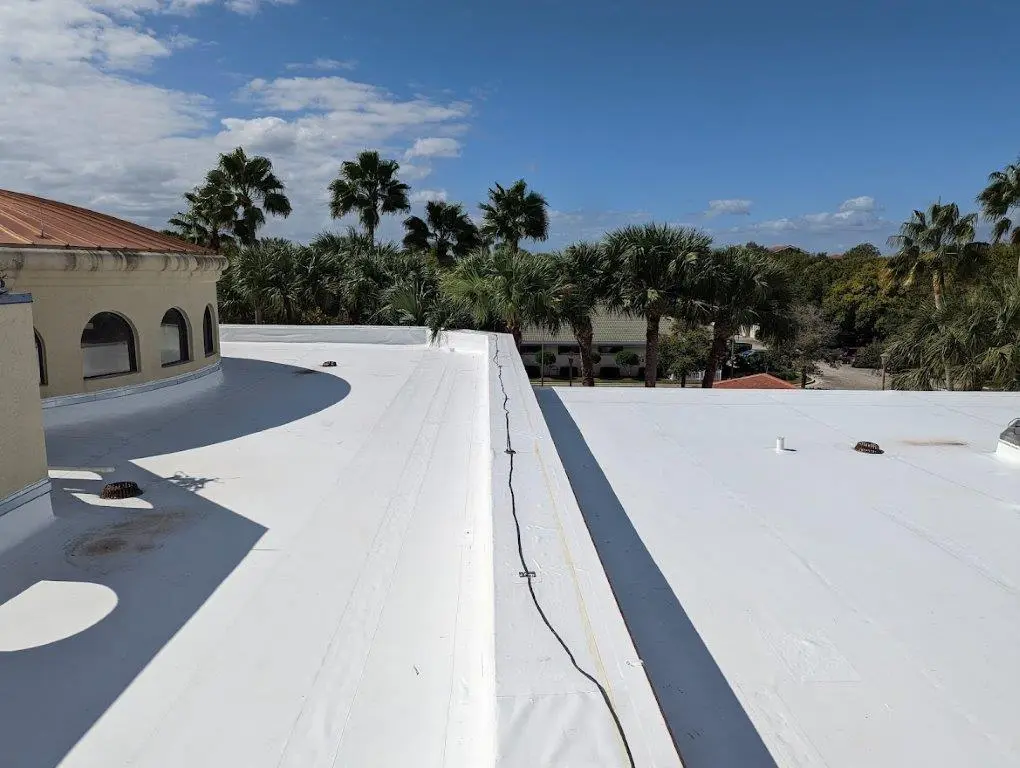
TPO is a thermoplastic. When two sheets are heat-welded, the material fuses — the sheets become one piece. A properly welded seam is stronger than the membrane either side of it.
Compare that with adhesive systems, where seams are bonded with glue or tape. Adhesive is a separate material with its own lifespan, and it ages differently from the membrane it's holding. Seams are where flat roofs leak, and TPO effectively removes the seam as a failure point.
Add a reflective white surface that sheds solar heat rather than absorbing it, and you have the system most Florida commercial buildings are now specified with.
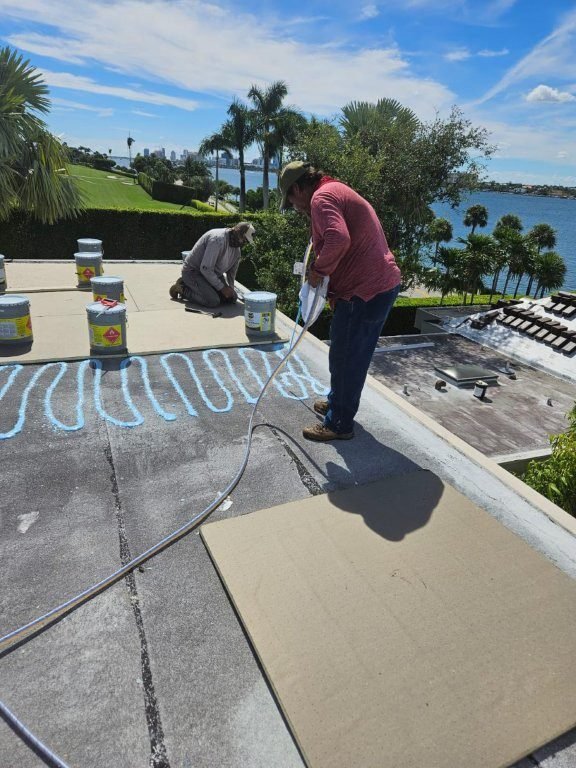
Heat-welded TPO — the seam becomes part of the membrane
The Thing That Actually
Kills Flat Roofs
Not the membrane. Not the weather. Standing water.
Industry standard treats water still sitting on a roof 48 hours after rain as ponding. It's the most common problem we're called about, and it is almost never the membrane's fault — it's slope, drains, or scuppers.
Ponding degrades the membrane surface, adds serious structural load (water weighs about 5 lbs per square foot per inch of depth), grows algae, and accelerates every other failure mode on the roof.
You May Have Been Told TPO "Resists Ponding"
It doesn't, and no membrane does. Standing water for more than 48 hours voids most TPO manufacturer warranties outright — it's written into the warranty document. If a contractor tells you ponding is fine because the membrane can handle it, ask to see that in writing from the manufacturer.
So We Fix Drainage First
Before we quote a membrane, we look at where water goes. Sometimes that means clearing and reworking drains and scuppers. Sometimes it means tapered insulation — insulation board cut to create slope, building positive drainage into a roof that never had any.
It adds cost. It also means your new roof doesn't fail the same way the old one did, and it keeps your warranty intact. A membrane installed over a drainage problem is an expensive way to buy the same problem again.
Membrane Thickness
TPO comes in different thicknesses, measured in mils. Two quotes can both say "TPO" and be materially different roofs — this is usually where the gap is.
The thinnest commonly available. Lowest cost, shortest warranty terms, least tolerance for foot traffic. We don't recommend it on anything with rooftop equipment or regular access.
The right answer for most Florida buildings. Meaningfully more puncture and weathering resistance than 45 mil for a modest cost difference, with access to longer manufacturer warranties.
Heavy duty. Worth it where there's real rooftop traffic, heavy HVAC servicing, or where the building's use makes a failure especially expensive.
When you compare bids, check the mil thickness on each one. If it isn't stated, ask — a 45 mil quote against a 60 mil quote is not the same roof, and the price difference between them is smaller than most people expect.
How the Membrane
Is Attached
Three methods, chosen by your building's deck, its wind exposure, and what's underneath.
| How it works | Best for | |
|---|---|---|
| Mechanically fastened | Plates and screws through the membrane into the deck, hidden under the next sheet's welded lap. | Most commercial roofs. Fastest, most cost-effective, excellent wind performance in a tested assembly. |
| Fully adhered | Membrane bonded across its entire surface to the insulation below. | High wind zones and exposed buildings. Smoothest finished appearance and the highest uplift ratings. |
| Induction welded | Membrane fused to specially coated plates through the sheet, with no fasteners penetrating the top surface. | Where you want adhered-level performance without the adhesive. Strong option in Florida's wind zones. |
Wind uplift ratings apply to the complete tested assembly — deck, insulation, attachment pattern, and membrane together. Change any one component and the rating no longer applies. FL5293.1 covers our standard assemblies.
TPO or Something Else?
TPO suits most Florida flat roofs. It doesn't suit all of them, and we'd rather tell you that here.
| Typical life | When it's the right call | |
|---|---|---|
| TPO | 20–30 years | The Florida default. Reflective, heat-welded seams, strong value. Offices, retail, warehouses, and residential flat sections. |
| EPDM rubber | 20–30 years | Exceptional flexibility and cold tolerance. Worth considering where chemical exposure or extreme building movement is a factor. Black surface absorbs heat. |
| Modified bitumen | 15–25 years | Multi-ply and highly puncture resistant. The right answer where there's regular foot traffic or heavy equipment servicing. |
| Silicone coating | 10–20 years | Restoration rather than replacement. Seamless, applied over a sound existing roof, and far cheaper than tear-off — if the insulation beneath is dry. |
Before You Replace, Ask About Restoration
If your existing membrane is sound and the insulation underneath is dry, a silicone coating can reset the clock at a fraction of tear-off cost — with no disruption to the building below.
The deciding factor is moisture, and it's measurable rather than a matter of opinion. We survey before recommending either. If your roof is a restoration candidate, that's what we'll quote — it's a smaller job and we'd rather you knew.
Flat Sections on
Florida Homes
Plenty of Florida houses have a flat or low-slope section — a Florida room, a carport, a rear addition, a mid-century home that's flat throughout.
These are frequently the part of the roof that leaks, and frequently the part that gets patched rather than properly addressed. A flat section tied into a tile or shingle roof needs the transition detailed correctly, and that junction is where we find most residential flat roof leaks.
TPO works well here. So does silicone coating on a sound existing surface. What doesn't work is another layer of patching over a section that's already been patched twice.
 -->
-->How a Flat Roof
Project Runs
Assessment and moisture survey
We walk the roof, check every drain and scupper, inspect penetrations and flashings, and establish whether the insulation beneath is wet. That last answer decides restoration versus replacement, and it's a measurement rather than a judgement call.
Drainage plan
Where water goes, and what needs to change so it goes there faster. Tapered insulation, additional drains, or reworked scuppers — priced separately so you can see exactly what you're paying for and why.
System specification
Membrane, thickness, insulation, and attachment method — chosen for your deck, wind exposure, and rooftop traffic. Named on the proposal, so you can compare it against anyone else's.
Tear-off and deck preparation
Old system removed, deck inspected and repaired, wet insulation replaced. We don't install over existing layers — it hides the deck condition, traps moisture, and disqualifies you from the better warranties.
Insulation and membrane
Insulation laid to the drainage plan, membrane installed to the specified attachment method, and every seam heat-welded and probe-tested. Perimeter, curbs, and penetrations detailed individually.
Inspection and close-out
County inspection passed, manufacturer inspection scheduled where an NDL warranty applies, and your full document package delivered — photos, permits, warranty registration, and a maintenance schedule.
What You Get From Us
Drainage Before Membrane
We price the drainage fix separately and explain it. A membrane over a ponding problem buys you the same failure again in ten years.
60 Mil as Standard
Not 45. The cost difference is modest and the difference in puncture resistance and warranty eligibility is not.
Seams Probe-Tested
Every weld checked with a probe before we call the roof finished. A weld that looks right and isn't is invisible until it rains.
Two State Licenses
Roofing CCC1332394 and general contracting CGC1533052. Deck repairs, curb work, and structural issues handled directly.
NDL Warranty Access
We can specify assemblies that qualify for manufacturer No Dollar Limit warranties — where the manufacturer inspects the finished roof, not just your contractor.
Maintenance Program
Twice-yearly inspections, drains cleared, seams checked. It protects your warranty — most manufacturers require documented maintenance.
TPO & Flat Roofing FAQs
What is a TPO roof?
A single-ply thermoplastic membrane for flat and low-slope roofs. Its defining feature is that seams are heat-welded rather than glued — the sheets fuse into one piece, and a properly welded seam is stronger than the membrane either side of it. The reflective white surface sheds solar heat, which matters in Florida.
How long does a TPO roof last in Florida?
20 to 30 years for a properly installed system with maintained drainage. Thickness matters — 60 mil outlasts 45 mil noticeably. The single biggest factor isn't the membrane at all: it's whether water drains off the roof. Roofs that pond fail early regardless of what's on them.
Does TPO handle standing water?
No membrane does, and you should be cautious of anyone who says otherwise. Water standing more than 48 hours voids most TPO manufacturer warranties — it's written into the warranty document. Ponding degrades the surface, adds structural load, and accelerates every other failure mode. If your roof holds water, drainage is the first thing to fix.
What thickness should I choose?
60 mil for most Florida buildings. It offers meaningfully better puncture and weathering resistance than 45 mil for a modest cost increase, and it qualifies for longer manufacturer warranties. Go to 80 mil where there's real rooftop foot traffic or heavy HVAC servicing. Always check which thickness a quote is based on — it's frequently left unstated.
Can TPO be installed over my existing roof?
Sometimes permitted, and we don't do it. Layering hides the deck condition, traps any existing moisture in the insulation, and disqualifies you from the better manufacturer warranties. On a roof meant to last twenty-five years, starting with unknowns underneath makes no sense.
TPO or EPDM — which is better?
For most Florida buildings, TPO — the reflective white surface suits our heat, and heat-welded seams outperform adhesive ones. EPDM is exceptional on flexibility and cold tolerance, and worth considering where chemical exposure or heavy building movement is a factor. Its black surface absorbs heat, which is a real disadvantage here.
Can I coat my flat roof instead of replacing it?
Often, and it's far cheaper. Silicone restoration works when the membrane is sound and the insulation beneath is dry. If moisture has reached the insulation, coating traps it and the roof fails faster than if you'd done nothing. We survey for moisture before recommending either.
Which areas do you serve?
We're licensed statewide, with crews working regularly through Martin, St. Lucie, Palm Beach, Broward, and Southwest Florida — including Stuart, Port St. Lucie, West Palm Beach, Boca Raton, Fort Lauderdale, Naples, and Fort Myers.
Related
For restoration rather than replacement, see silicone roof coating. For the full commercial picture — condition reports, warranties, scheduling around your business — see commercial roofing.
Also relevant: roof leak repair if you're chasing a specific leak, 24/7 emergency response, and free roof inspections. For sloped sections of the same building, compare standing seam metal and architectural shingle.
Find Out Why Your
Flat Roof Is Failing
Free assessment with drainage review and moisture survey, photographs of what we find, and options priced separately — restoration and replacement, so you can see the real difference.