
Storm Damage
Roof Assessment
Most storm damage isn't visible from your driveway. We get on the roof, document what the wind actually did, and give you the file — whether or not you ever hire us to fix it.
The First 72 Hours,
In Order
If a storm has just passed and your roof took it, this is the sequence that matters. None of it requires a contractor and all of it is worth doing today.
Stay off the roof
Not to look, not to tarp, not to sweep debris. Wet roofing, loose material, and hidden soft spots are how homeowners get seriously hurt after storms. Everything below is done from the ground or inside. If there's a downed line anywhere near your property, stay well clear and call your utility.
Photograph everything, before you tidy
Wide shots of each elevation from the ground, then close-ups of anything obvious — displaced tiles, debris, a dented gutter, shingles in the yard. Photograph the yard too. That branch on your lawn is evidence, and it stops being evidence the moment you drag it to the kerb.
Check inside, room by room
Ceilings, wall corners, around light fixtures and vents. Look in closets and the backs of cupboards — water shows there first because nothing is disturbed. Photograph any stain, however small, with something for scale.
Look in the attic if you safely can
A flashlight and five minutes. Daylight where there shouldn't be any, damp or matted insulation, dark staining on the decking. Photograph what you find. This is where storm damage shows up long before your ceiling tells you.
Note the date and the storm
Which storm, what date, when you first noticed anything. Sounds trivial. Establishing when damage occurred is far easier now than three months from now, and it's one of the first things you'll be asked.
Contact your insurance agent
Not us — your agent. They can tell you what your policy covers, what your deductible is, and what deadlines apply. Florida has notice deadlines for property claims and they're shorter than most people assume. Ask your agent specifically what yours are.
Get the roof properly assessed
Once you've done the above. A ground-level look tells you very little — the damage that matters is usually only visible from the roof itself. That's the part we do.
Your Roof Can Look
Fine and Not Be
The most expensive storm damage is the kind you can't see from the ground — and it's the reason roofs start leaking months after the storm that damaged them.
Lifted and reseated shingles. Wind gets under a shingle, breaks the adhesive seal, and lays it back down. From the street it looks untouched. The seal is gone, and the next storm takes it.
Loosened fasteners. Sustained uplift works nails and screws. Nothing has moved yet, but the roof's hold on the deck has been reduced.
Hairline-cracked tiles. Impact from debris cracks tile without displacing it. The crack is invisible from below and water finds it immediately.
Displaced flashing. Wind lifts flashing at walls and chimneys just enough to break the seal. It sits back down looking normal.
None of that shows up in a photo from your driveway. All of it shows up in your ceiling, eventually.
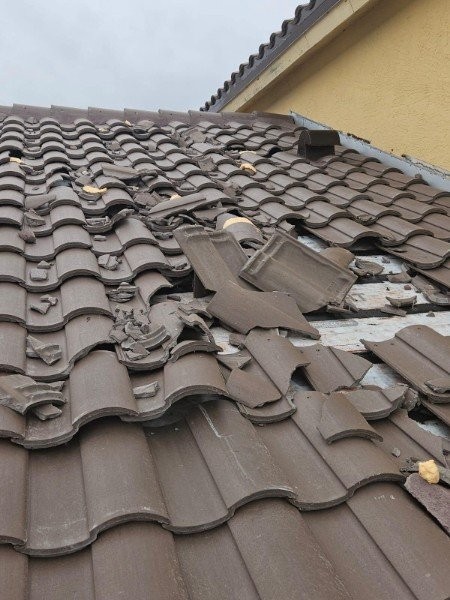
Storm Damage
by Roof Type
Different systems fail differently. Knowing what to look for on your specific roof is most of the job.
| What we check | |
|---|---|
| Shingle | Broken adhesive seals from uplift, missing or creased tabs, granule loss exposing the mat, damaged ridge cap, and impact bruising from debris. Seal failure is the big one and it's invisible from the ground. |
| Tile | Cracked, chipped, or slipped tiles, broken mortar at ridges and hips, and displaced field tile. We also check the underlayment beneath — wind-driven rain gets past tile by design, and that layer is what stopped it. |
| Metal | Seam separation, panel deflection, backed-out fasteners on exposed-fastener systems, and damaged closures at ridge and eave. Denting from debris, which is cosmetic on some systems and not on others. |
| Flat & low-slope | Membrane punctures from flying debris, seam separation, lifted or damaged flashing at curbs and penetrations, and blocked drains that are now holding water on the roof. |
We photograph everything we find and everything we check that's sound. A report that only shows damage is less useful to you than one that shows the whole roof.
What We Do,
and What We Don't
We're Roofing Contractors
We assess roofs, document what we find, and repair or replace them. That's the licence we hold and the work we do.
What We Give You Instead
A thorough, dated, photographic record: the condition of every part of your roof, what we believe caused any damage found, and what repair or replacement would involve. That file belongs to you. Take it to your agent, your adjuster, a public adjuster, or another contractor for a second opinion. We'd rather you have good information than depend on us for it.
Talk to your insurance agent about coverage and deadlines. They're the ones who can actually answer those questions, and they should be your first call.
How a Storm
Assessment Runs
We schedule and confirm access
After a major storm, demand spikes and everyone calls at once. We'll give you a realistic window rather than a promise we can't keep. If water is actively coming in, say so — that changes the priority immediately.
Ground and elevation survey
Each elevation photographed, plus debris, gutters, fascia, soffit, and anything in the yard that came off the roof. Context matters as much as close-ups.
Roof-level inspection
Every plane walked where it's safe to do so. Seal integrity, fastener condition, flashing, penetrations, ridges, valleys. This is the part that finds what nobody could see from below.
Attic and interior
Where access exists. Daylight, damp insulation, staining on decking and framing. Interior ceilings and walls photographed room by room.
Written report, delivered to you
Dated photographs organised by area, what we found, what we believe caused it, and what the repair or replacement involves. Yours to keep and to share with whoever you choose.
Repair or replacement quoted
Line-item pricing in writing, with no pressure to decide while you're still dealing with everything else. If the damage is minor and doesn't warrant work, we'll tell you that too.
About the Trucks That Show Up After a Storm
Within days of any significant Florida storm, out-of-state crews arrive and start knocking doors. Some are perfectly good operations. Many are unlicensed, uninsured, and gone before the first winter — along with your deposit and any warranty they promised.
Three things to check on anyone who knocks, including us:
Ask for the Florida licence number and verify it at the DBPR licensee search — it takes thirty seconds on your phone. Ask for a local address you could actually drive to. And never pay a large deposit up front to someone who arrived unsolicited.
Ours are CCC1332394 and CGC1533052. We're in Stuart, we're here year-round, and we'll be here when your warranty matters.
What Makes Us Different
We Document Everything
Dated photographs of the whole roof, not just the damaged parts. Organised, thorough, and handed to you as a file you own.
Local, Not a Storm Crew
Based in Stuart, working Florida year-round. We're here for the warranty, not just the fortnight after the storm.
Clear About Our Role
We're contractors, not adjusters. We'll tell you what we found and leave the claim to the people licensed to handle it.
Two State Licenses
Roofing CCC1332394 and general contracting CGC1533052. Storm damage to fascia, soffit, or framing handled directly.
We'll Say It's Minor
If the storm didn't do much, that's what the report will say. Not every storm damages every roof, and we'd rather be right than busy.
Family-Owned
This is a family-owned business. Ronny Hanna quotes the work, oversees the crews, and answers the phone himself.
Storm Damage FAQs
How do I know if the storm damaged my roof?
Often you can't tell from the ground, which is the whole problem. The most consequential storm damage — broken adhesive seals on shingles, loosened fasteners, hairline cracks in tile, lifted flashing — is invisible from below and shows up as a leak months later. A ground-level look is worth doing, but it isn't an assessment.
Should I get my roof checked if I can't see any damage?
After a significant storm, yes. It costs you nothing, you keep the report either way, and if the roof is sound you'll have that documented with a date on it. That's genuinely useful later — both if a problem emerges and when you eventually sell.
Do you handle my insurance claim?
No. Handling claims on a homeowner's behalf is a separately licensed profession in Florida — public adjusting — and we'd be cautious of any roofer who offers to do it. What we provide is thorough dated documentation of what we found and what caused it. That file is yours to take to your agent, your adjuster, or a licensed public adjuster if you choose to engage one.
How long do I have to report storm damage?
Florida has notice deadlines for property insurance claims, and they're shorter than most people assume. They also depend on your policy and when it was written. Ask your insurance agent specifically what applies to you — this is exactly the kind of question they're there to answer, and it's worth asking early rather than late.
What should I do before you arrive?
Photograph everything from the ground before you tidy up, check inside room by room including closets, look in the attic if you can do it safely, and note the storm and date. Full sequence is near the top of this page. Don't go on the roof — that's the one thing worth being firm about.
How quickly can you come out after a storm?
Response times stretch considerably after a major storm because everyone calls at once. We'll give you a realistic window rather than a promise we can't keep. If water is actively coming into the building, tell us — that goes to the front of the queue, and you should see our emergency roof repair page.
Can storm damage be repaired, or does the roof need replacing?
Both happen. Isolated damage on a sound roof is a repair. Widespread seal failure across a shingle roof usually isn't — the roof will keep failing in new places. Florida's code generally allows localised repair where work affects less than 25% of the roof area in any twelve-month period. We'll tell you honestly which side of that line your roof sits on.
Which areas do you serve?
We're licensed statewide, with crews working regularly through Martin, St. Lucie, Palm Beach, Broward, and Southwest Florida — including Stuart, Palm City, Port St. Lucie, Jupiter, West Palm Beach, Boca Raton, Fort Lauderdale, Naples, Fort Myers, and Cape Coral.
Related
Water coming in right now? Emergency roof repair — answered 24 hours. Seeing a stain but no obvious storm damage? Roof leak repair traces it to the source.
If the assessment points to replacement, see roof replacement — and book a wind mitigation inspection once it's done, since a new roof usually improves several categories at once. For commercial and HOA properties, see commercial roofing.
Find Out What the
Storm Actually Did
Free assessment, the whole roof photographed and dated, and a written report you keep either way. If the damage is minor, that's what it will say.