Metal Roof Replacement
& Installation
Roughly twice the life of shingle — but only if two decisions are made correctly before a single panel goes up: which metal, and how it's fastened. Get those wrong and a fifty-year roof becomes a fifteen-year one.
Near Salt Water, the Metal
Matters More Than the Profile
Most metal roofing sold in Florida is galvalume — steel with an aluminium-zinc coating. Inland, it's excellent material. Within sight of salt water, it's the wrong answer, and the corrosion that proves it starts at the cut edges and fasteners years before you can see it from the ground.
That's why manufacturers themselves restrict or void galvalume warranties within a set distance of the coast — typically anywhere breaking waves or salt spray can reach the panel. Barrier islands, riverfront, Intracoastal: that's aluminium territory.
We specify aluminium as standard on coastal work, with stainless fasteners, and we'll show you the manufacturer's own coastal warranty language so the decision is based on documents, not a salesman's confidence. It costs more per square. It's also the difference between a roof that reaches year fifty and one that's bleeding rust streaks at year twelve.
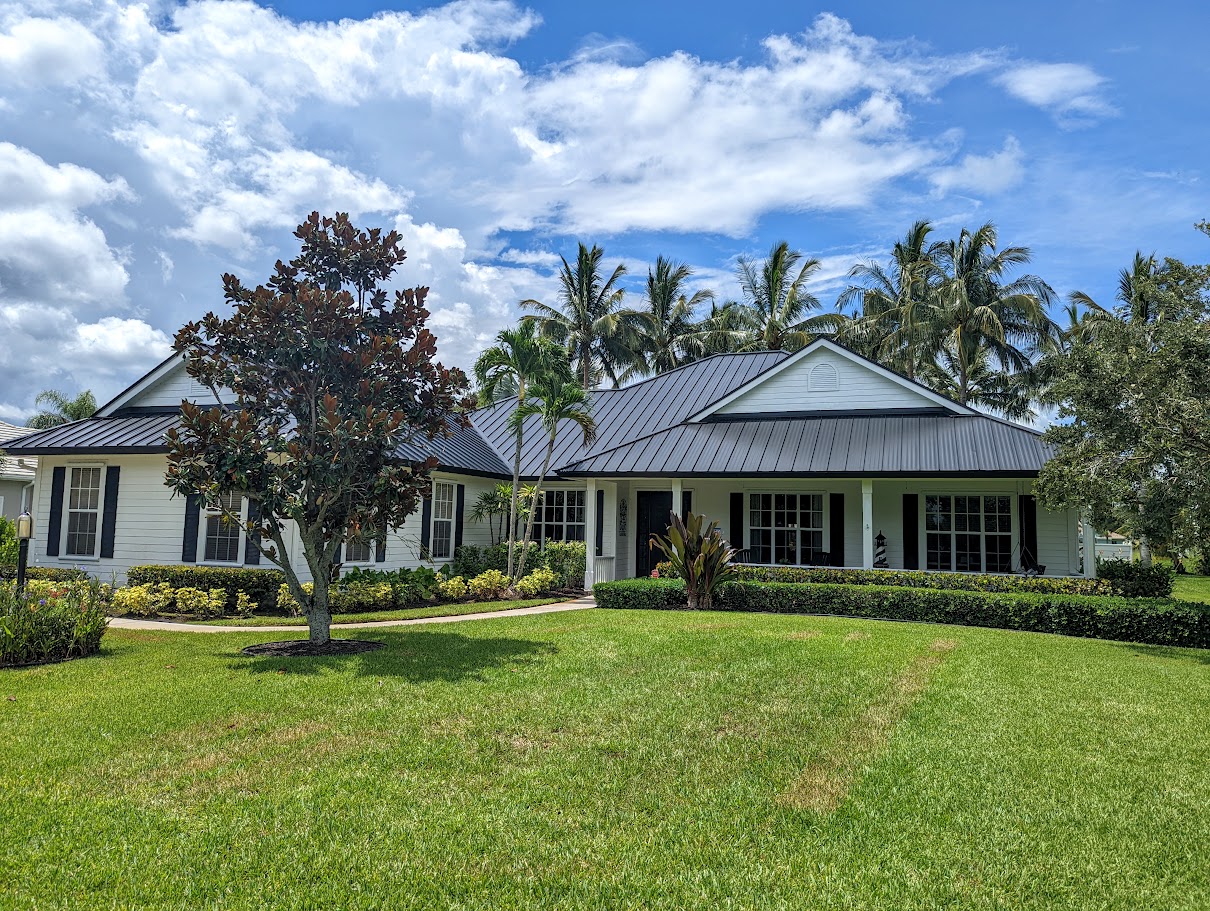
Metal Roof Replacement by Expert Roofing Services
Concealed, Exposed,
or Stone Coated
Every metal roof in Florida is one of three systems, and the real difference between them is how they're fastened — because on a metal roof, the fasteners are what age, not the panels.
Standing Seam
Panels lock together at raised seams and attach with hidden clips — no fastener penetrates the weather surface, and the panels can expand and contract freely in Florida heat. The longest-lived, lowest-maintenance metal system made.
5V Crimp & PBR Panel
The classic Florida look — Old-Florida and Key West vernacular for 5V, agricultural and commercial strength for PBR. Screws with sealing washers fasten through the panel face, which makes installation faster and the price meaningfully lower.
Stone Coated Steel
Steel panels pressed into tile and shake profiles and finished with stone granules — the look of tile at a quarter of the weight. An answer for homes whose structure can't carry concrete tile but whose HOA expects the tile look.
Metal Systems for Florida Homes
Every system below carries Florida Product Approval and is installed to the fastening schedule your wind zone requires — including High-Velocity Hurricane Zone assemblies where your address demands them.
Standing Seam
Mechanically seamed and snap-lock profiles in aluminium and galvalume. Hidden clips, free thermal movement, and the cleanest lines in roofing.
Standing Seam → Exposed Fastener5V Crimp
The panel that built Old Florida. Five distinctive V-ribs, honest pricing, and the right look on cottages, Key West styles, and historic homes.
5V Metal → Exposed FastenerPBR Panel
The structural workhorse — deep ribs and purlin-bearing legs for commercial, agricultural, and residential projects that need strength per dollar.
PBR Metal → Tile & Shake ProfilesStone Coated Steel
Tile and shake looks at a fraction of the weight, with the wind performance of interlocked steel panels beneath the granule finish.
Stone Coated →What Metal Roofing in Florida Actually Involves
—Oil canning — we disclose it up front
Flat areas of metal panel can show a wavy, rippled appearance in certain light. It's an inherent visual characteristic of light-gauge metal, not a defect, and no contractor can guarantee its absence. We put that in writing before you sign — because finding it in paragraph 14 after installation is how metal roofs end up in disputes.
—Gauge and finish
Panel thickness (gauge) and paint system decide how the roof looks in year twenty. We quote the gauge and the finish — PVDF (Kynar) versus polyester — by name on every proposal, so you're comparing like with like when another bid arrives.
—What goes underneath
Metal sheds water; the underlayment waterproofs the roof. Under metal we install high-temperature self-adhered membrane rated for the deck temperatures a Florida metal roof generates — standard underlayment cooks beneath metal and fails early.
—Dissimilar metals
Copper, treated lumber, and even algae-resistant shingle granules can set up galvanic corrosion against aluminium and galvalume. Flashings, fasteners, and contact points all have to be compatible — it's detail work that's invisible on day one and decisive by year ten.
—Wind zone and HVHZ
Your address sets the design pressures, which set the clip spacing, fastening schedule, and which product approvals are even eligible. High-Velocity Hurricane Zone work in Broward and Miami-Dade uses its own approval system entirely. It's all documented in the permit file you keep.
—Insurance and energy
A new metal roof resets your roof age for underwriting and typically documents well on a wind mitigation inspection. The reflective finishes also lower attic temperatures — cooling savings of up to 25% are commonly cited for reflective metal in Florida.
Two Things You Can Check on an Existing Metal Roof
Look at the screw lines on an exposed-fastener roof. Backed-out screws catch light and cast small shadows in rows. Each one is a washer no longer sealing — a ten-minute fix now, a decking repair after two rainy seasons.
Look for rust streaks below cut edges and penetrations. On coastal galvalume, edge creep shows as faint tea-coloured staining running downslope. Caught early, it's manageable. Ignored, it's the beginning of the alloy argument above.
Metal Roofing FAQs
How long does a metal roof last in Florida?
Properly specified and installed, 40–70 years — roughly twice the life of architectural shingle. The range depends mostly on the two decisions this page keeps returning to: the metal (aluminium near salt water) and the fastening system (concealed outlasts exposed). The panels themselves almost never fail first.
Aluminium or galvalume — which do I need?
Inland, galvalume is excellent and costs less. Near salt water — barrier islands, riverfront, Intracoastal — aluminium, full stop. Manufacturers restrict their own galvalume warranties near the coast, and we'll show you that language in the product documents rather than asking you to take our word for it.
Is standing seam worth the premium over 5V?
Usually, if you're staying in the home. Standing seam's hidden clips mean no exposed washers ageing in UV and no fastener maintenance cycle, and it typically documents better for wind performance. 5V is the honest budget answer and the correct aesthetic on Old-Florida and Key West style homes — but plan on fastener checks from around year ten.
What is oil canning, and should I worry about it?
A wavy appearance that can show in the flat areas of metal panels in certain light. It's cosmetic, inherent to light-gauge metal, and excluded from every manufacturer's warranty in the industry. We disclose it in writing before contract. Wider ribs, striations, and heavier gauge all reduce it — we'll walk you through those options if appearance in raking light matters to you.
Are metal roofs loud in the rain?
Not on a modern installation. The panels go over solid decking and underlayment — not open framing like a barn — so rain noise is comparable to shingle or tile. The tin-roof drumming people remember comes from panels on open purlins.
Will a metal roof lower my insurance?
It resets your roof age for underwriting — often the single biggest factor in Florida premiums — and metal systems typically document well on a wind mitigation report. We include the wind mitigation documentation with the job, so the features you paid for are actually recorded.
Can you install metal over my existing shingles?
Florida code allows it in limited circumstances, but we rarely recommend it. Covering the old roof means never inspecting the decking beneath — and rotted decking under a fifty-year roof is a problem you've sealed in, not solved. A tear-off with decking priced per sheet up front costs a little more now and removes the biggest unknown.
How long does a metal roof installation take?
A typical residential standing seam or 5V job runs about one to two weeks once material arrives — tear-off, dry-in, then panels. Panel fabrication lead time varies by profile and colour, from days to several weeks, and we tell you the realistic schedule before you commit.
Get the Alloy and Fastening
Specified Correctly
Free inspection with photographs, a written spec that names the metal, gauge, finish, and fastening system — and manufacturer coastal warranty language you can hold every bid against, including ours.